
What Change Management Can Teach Us About AI
For many leaders, AI started as a simple nudge to experiment with tools like ChatGPT or Claude. It has since evolved into a much larger conversation about how businesses need to operate differently, and what that means for the people leading them. Leaders are increasingly expected to understand the role AI can play within their function, while helping their teams navigate the change that comes with it.
Rebecca Blanksma, AI Strategy & Enablement Lead, discussed this topic during a recent webinar. Having spent much of her career helping teams navigate periods of significant transformation, Rebecca offered an important perspective: while AI may be new, many of the leadership challenges we are facing are familiar.
So, what can the fundamentals of change management teach us about moving forward when no one has all the answers?
Lesson 1: Get Comfortable Being a Beginner Again
Strong leaders routinely manage people with deeper expertise than their own. A President does not need to be the strongest developer, salesperson or finance professional in their business. Their role is to ask the right questions, offer direction and bring together the people and resources needed to make progress.
AI doesn’t fundamentally change that responsibility, but it can challenge a leader’s comfort with it. After spending years building expertise in a market or function, suddenly becoming a beginner again can be uncomfortable. Rebecca spoke candidly about the role ego can play, particularly when members of your team may already be further ahead.
Rather than trying to close the gap before joining the conversation, leaders can acknowledge it. Being willing to say, “I haven’t figured this out yet,” creates space for others to do the same. Questions and challenges are more likely to surface, while giving those with deeper knowledge an opportunity to contribute their expertise.
Lesson 2: Understand and pre-empt the “Valley of Despair”
Most initiatives begin with genuine optimism: a problem to solve, a capability to explore, or a better way to work. Rebecca used the Kübler-Ross Change Curve to illustrate what often happens when that initial enthusiasm meets the reality of implementation.
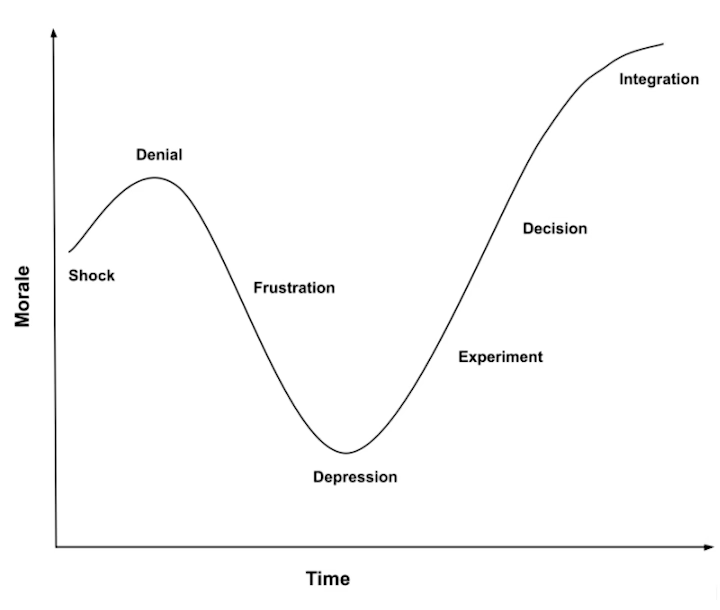
As teams begin putting new ideas into practice, expectations inevitably collide with limitations. Progress can be slower than anticipated, early experiments may fall short, and what initially seemed straightforward becomes more complex. Rebecca described this as the “valley of despair,” the point where frustration and fatigue begins to set in.
Recognizing this stage can shape how leaders respond to it. A failed experiment doesn’t necessarily mean the broader initiative is failing, and frustration isn’t always a sign of resistance. Sometimes a team is simply in the difficult middle, where the potential is clear, but the path forward is still being worked out.
Lesson 3: Rigorously Revisit Your “Why”
One observation Rebecca has made among teams taking a thoughtful and meaningful approach to AI is that they tend to have a clear understanding of why they are using it in the first place. The strongest use cases are not driven by a general desire to “use more AI,” but by a specific problem or opportunity where the technology can make a meaningful difference.
That “why” will look different across teams. For one function, it might mean reducing administrative work that consumes hours each week. For another, it could be giving employees faster access to information, improving a customer workflow or helping developers move from an idea to something testable more quickly.
Having this clarity becomes particularly valuable when experimentation gets difficult.
Lesson 4: Build a Community of Practice
As AI experimentation grows, so does the opportunity for people to learn from one another. Rebecca recommends developing some form of “community of practice” where employees can regularly share what they are testing, what is working and, just as importantly, where they are getting stuck.
This community does not need to be formal; it can be a roundtable, Teams or Slack channel, or simply “phoning a friend”. The goal is to create regular opportunities for knowledge to move between people rather than experimenting in isolation.
In Conclusion: The Fundamentals of Leading Change Still Apply
AI is moving so quickly that even the people who work with it every day are still learning. This can make leading through the change harder, as the gap between learning something yourself and helping someone else understand it has narrowed.
Still, leaders have been here before. Leave room to experiment without treating every experiment as a commitment. Make it safe to say what isn’t working, and when something does work, find a way for that learning to travel!
Back to Insights